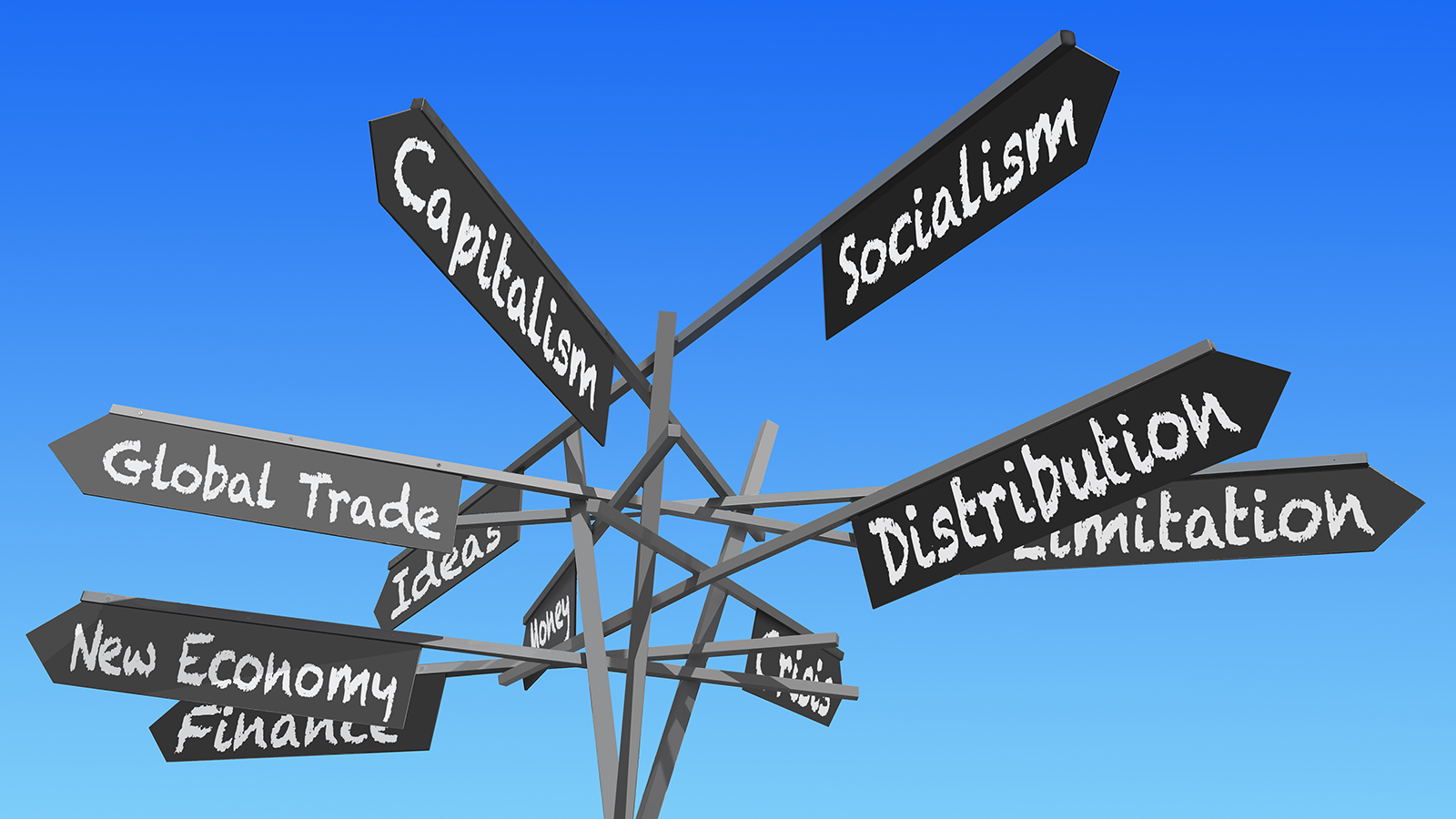
Capitalism, socialism, and communism are three key concepts in social studies, with complex definitions and complicated histories. Explaining these concepts in the classroom is muddled even more by how these words are used in modern media. The meaning is often obscured by political alliances and deliberate attempts to mislead.
The words capitalism, socialism, and communism describe different economic systems. A simple and effective way to present these key concepts in the classroom is through the economic continuum illustrated by the chart below. Students are much more likely to grasp the key differences if these concepts are first presented separate from political systems such as autocracy, theocracy, or democracy.
Capitalism, socialism, and communism are also easier to understand and remember when the histories of the words are explored.

Photo: iStock by Getty Images
Economic Terms Defined
Capitalism and socialism first came into use in the 1830s. Capitalism described an economic system in which wealth (or capital, another word for wealth) was owned by individuals for their personal profit. The British policy of government regulation of trade called mercantilism was being abandoned by the 1830s, and the free market (not the government) determined the production and distribution of goods. The word capitalism was a product of the changing economy of Great Britain during the Industrial Revolution.
The word socialism also began to be used in the 1830s, to describe a system different from capitalism. Socialism held that groups of people should own and regulate the economy for the benefit of all the members, not just a few. Early nineteenth-century socialists were often disturbed by the economic and social changes caused by the Industrial Revolution. In the first half of the nineteenth century, socialist ideals inspired utopian communities such as the transcendentalists’ Brook Farm, Robert Owen’s New Harmony, and the Oneida Community. An even older ideal of Christian socialism described in the Bible inspired religious socialist communities such as the Shakers, Rappites, Amana Colonies, and Hutterites. Even the term social studies alludes to how a community or wider society benefits from shared knowledge.
Communism was first a French word, coined in the 1840s, to describe a system of collective ownership in which individuals did not own private property and worked together for the benefit of all community members. This new French word described ideals similar to the English concept of socialism and derived from the word common, meaning something is free or open to everyone.
The word communism was adopted by Karl Marx and Frederick Engels in the 1850s to describe their ideology of opposing industrial capitalism. Marxist communism sought the overthrow of governments supporting a capitalist economy. By 1918, communism was the ideology of Russia’s Bolshevik Revolution and was associated with a single authoritarian political party. The combined economic and political ideology of modern communism was implemented in the Soviet Union (1922), the People’s Republic of China (1949), North Korea (1948), North Vietnam (1945), and Cuba (1965).

Photo: iStock by Getty Images
Modern Day Implications
Today, the historical words capitalism, socialism, and communism do not fully capture the economic systems of nations. New words are also used to describe economic systems: free market system; mixed economy; command economy. But these modern words can still lead to confusion because, in reality, modern nations are not purely free market capitalist or purely command/communist. In recent years, communist China and Cuba have loosened economic restrictions and allowed free market activities. On the other hand, the United States regulates many aspects of its economy and owns and manages very “socialist” enterprises such as public schools, public transportation, and public libraries.
In other words, communism, socialism, and capitalism are a continuum, with modern national economics falling somewhere in the middle, or mixed, zone. In American politics, those aligned to the right of the political spectrum are more likely to support free market policies, and those to the left are more likely to support government intervention in the economy. Recent polls by the Pew Research Center demonstrate how the political alliances of Americans influence perceptions of these words.
Ultimately, nations and citizens of nations must decide how much government regulation of the economy is appropriate. Therefore, a clear understanding of the historical developments, meaning, political associations, and synonyms of these three words is essential in social studies.
Economic Systems |
|||
| Communism | Socialism | Capitalism | |
| Government owns/regulates all aspects of the economy. | Government owns/regulates some parts of the economy for the benefit of the whole nation;
and Individuals and private businesses also their own make their own economic decisions, keeping the profits and accepting the losses. |
Individuals and private businesses own everything and make economic decisions free from government regulation, keeping the profits and accepting the losses without intervention. | |
| Also known as:
Command Economy |
Also known as:
Mixed economy |
Also known as: Free Market Economy or Free Enterprise |
|
| Usually aligned to the political left | Usually aligned to the political right | ||

Active Classroom can aid your classroom with hundreds of activities about Economics
Access a free trial and start engaging students today
Cynthia W. Resor is a social studies education professor and former middle and high school social studies teacher. Her dream job? Time-travel tour guide. But until she discovers the secret of time travel, she writes about the past in her blog, Primary Source Bazaar. Her three books on teaching social history themes feature essential questions and primary sources: Discovering Quacks, Utopias, and Cemeteries: Modern Lessons from Historical Themes; Investigating Family, Food, and Housing Themes in Social Studies and Exploring Vacation and Etiquette Themes in Social Studies.
Thank you for this article. I greatly enjoyed reading it. I am going to look for books by Cynthia W Resor. I would like to learn more. I usually read about science and mathematics.
I am trying to recall an old saying that used a cow and her milk to show how each was distributed via 5 various “isms”. ie. a capitalist sells the milk, keeps the milk and the profit; a communist does’t own the cow, mills the cow and earns a wage.
Can you help me? I think I first read it in the ‘70’s. I would like to pass it on to my friends and family. Thank you, Steve Chase. shchase@msn. com
Socialism: You have two cows.
Give one cow to your neighbor.
Communism: You have two cows. Give both cows to the government, and they might give you some of the milk.
Fascism: You have two cows. You give all of the milk to the government, and the government sells it.
Nazism: You have two cows. The government shoots you and takes both cows.
Anarchism: You have two cows. Keep both of the cows, shoot the government agent and steal another cow.
Capitalism: You have two cows.
Sell one cow and buy a bull.
Thank you for this very clear and concise explanation. I searched through many sites before landing on yours and finally found the answers I was looking for.
this was a great way to describe the difference between these 3 complicated words that were for me. thank you so much!
As a lower-middle class (naturally born) American citizen, with a private home and two cars, level ‘B’ grade cards throughout my schooling, zero inherited wealth, who successfully raised 4 wonderful children to adulthood, I would have but one question: Under what economic system would I have had more personal wealth, personal freedom and personal happiness than Capitalism?
Reggie, your question implies the answer yes? My question to you is: have you in fact lived your life within a purely capitalistic system? Have you benefitted in any way from governmental socialism? Do you drive your two cars on roads built through the taxes you pay to the government? Obey traffic safety laws devised and implemented by the government? Is your electricity provided by power systems constructed by the government? Was the education you and your children received attained at public institutions? Have you ever received governmental assistance such as unemployment compensation, student loans or health care (i.e. medicaid). I will assume you are not old enough to receive social security or medicare, but I am – and at some point you will also. I am grateful to have been born and to live in this country, and to enjoy the freedoms it allows me. My personal freedom, wealth and happiness are important – but not to the extent that they trample on or impede the ability of other citizens to enjoy those same rights. Thus my belief is that Capitalism requires a Socialist component.
That’s one way to look at it, but there is a word that separates one from the other and that is “accountability”
Gregory, your question implies the answer yes? My question to you is: have you in fact lived your life within a purely capitalistic system? Have you benefitted in any way from governmental socialism? Do you drive your two cars on roads built through the taxes you pay to the government? Obey traffic safety laws devised and implemented by the government? Is your electricity provided by power systems constructed by the government? Was the education you and your children received attained at public institutions? Have you ever received governmental assistance such as unemployment compensation, student loans or health care (i.e. medicaid). I will assume you are not old enough to receive social security or medicare, but I am – and at some point you will also. I am grateful to have been born and to live in this country, and to enjoy the freedoms it allows me. My personal freedom, wealth and happiness are important – but not to the extent that they trample on or impede the ability of other citizens to enjoy those same rights. Thus my belief is that Capitalism requires a Socialist component.
Gregory, your question implies the answer yes? My question to you is: have you in fact lived your life within a purely capitalistic system? Have you benefitted in any way from governmental socialism? Do you drive your two cars on roads built through the taxes you pay to the government? Obey traffic safety laws devised and implemented by the government? Is your electricity provided by power systems constructed by the government? Was the education you and your children received attained at public institutions? Have you ever received governmental assistance such as unemployment compensation, student loans or health care (i.e. medicaid). I will assume you are not old enough to receive social security or medicare, but I am – and at some point you will also. I am grateful to have been born and to live in this country, and to enjoy the freedoms it allows me. My personal freedom, wealth and happiness are important – but not to the extent that they trample on or impede the ability of other citizens to enjoy those same rights. Thus my belief is that Capitalism requires a Socialist component.
Thank you. I like capitalism with a socialism component. I would hate to have to build the roads, schools, and electricity ,etc, that I use without thinking that they are supported by our taxes. While making jobs available to support our families.
Dear Cynthia Resor,
Thank you for this thought provoking essay!
I have long wondered how the US military fits into the economic continuum puzzle that you present and discuss.
I Have a Plethora of Questions (some few below):
1. Is the US military a socialist enterprise? There are so many benefits for an enlisted woman or man…. the benefits are free food, free healthcare, free housing and free travel benefits. A young person is often tempted to join the military because job alternatives to military service are often very challenging. All one has to do is obey Central Command. Benefits can carry on via the Veterans Administration for a lifetime. For myself, I was drafted into the American War on Viet Nam in 1965. I went kicking and screaming, but finished my term of enlistment and got my BFA degree on the G.I. Bill at “We the Taxpayers” expense. So… there’s a mix of very good and extreme bad. I am now proudly a member of Veterans For Peace!
2. Is the Military Industrial Complex (MIC) that profits from “defense” and war activities …. with very little regulation or oversight, and supported by “We the Taxpayers”, a “free market” capitalist system or is the MIC taking advantage of and even encouraging such opportunity in the form of ever greater “endless foreign wars” economy government contracts?
3. Are the jobs created via the MIC an offshoot of the “free market” or is it a “socialist-style jobs program” that encourages US Congress-persons to vote for annual National Defense Authorization Act (s) (2027 military budget is $1.5 trillion, up 67% from 2026) that fuels a “defense” contract war economy – state by state and voting district by voting district?
4. How should “We the Taxpayers” respond to the finger pointing at those who would like to have a much greater percentage of discretionary spending go toward universal healthcare, free higher education, subsidized housing and other programs that actually benefit humanity?
I would really like to hear your opinion on this sensitive and rarely, if ever discussed topic
Kind regards,
Michael